I have been revisiting the metamodel for my Digital Enterprise Operating Model. The question sounds deceptively simple: what are the fundamental areas that need to be represented if the model is to describe how a digital enterprise actually works?
A useful metamodel must represent what the enterprise seeks to achieve, the value it provides, how people organize and perform work, what capabilities and assets it depends on, and the conditions under which it must operate. It must also connect these perspectives without forcing fundamentally different concepts into a single hierarchy.
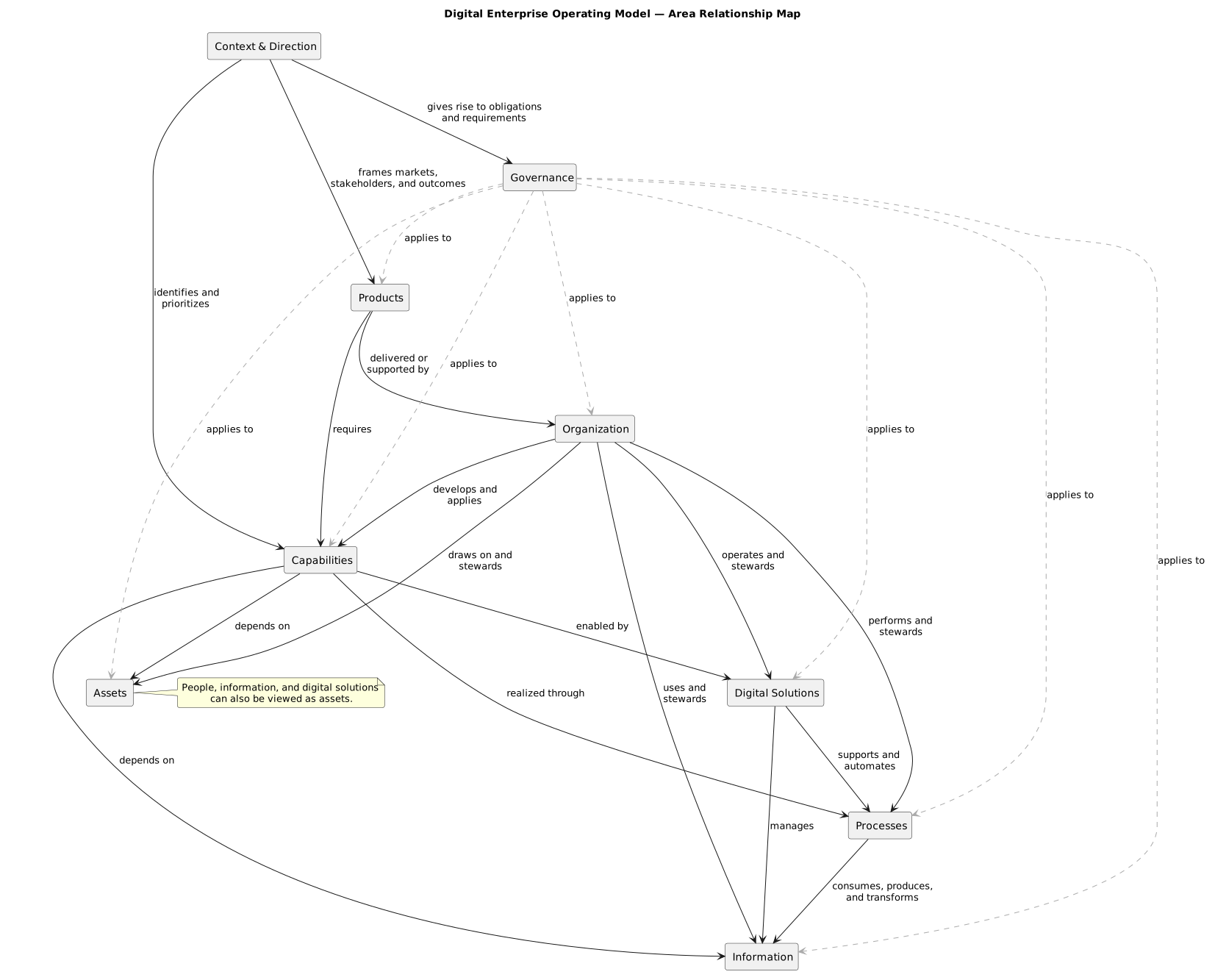
The result is a model organized around nine connected areas.

Areas are perspectives, not silos
The purpose of these areas is not to divide the enterprise into nine independent repositories. A digital enterprise is a connected system, and almost every meaningful question crosses several areas.
A product, for example, is offered to a market, delivered or supported by enterprise services, realized through capabilities and processes, supported by people, information, systems, and other assets, and constrained by governance. None of those perspectives provides a sufficient model on its own.
The areas should therefore be understood as entry points into the same enterprise model. They help us ask different questions about the enterprise while preserving the relationships needed to move between the answers.
| Area | Central question | Typical concepts |
|---|---|---|
| Context & Direction | Why does the enterprise exist, and where is it going? | Purpose, strategy, objectives, outcomes, markets, stakeholders |
| Products | What value does the enterprise provide? | Products, services, value propositions, features, functional requirements |
| Organization | How is the enterprise organized to deliver its outcomes, and where do authority and accountability sit? | Enterprise services, teams, organizational units, roles, responsibilities, decision rights |
| Capabilities | What must the enterprise be able to do? | Business capabilities, maturity, capacity, competency |
| Processes | How is work performed and coordinated? | Value streams, processes, activities, decisions, events |
| Information | What does the enterprise know and use? | Information models, information objects, information groups, information packages, data models, records, data products, classifications |
| Digital Solutions | Which technology realizes the enterprise’s digital services? | Digital solutions, systems, interfaces, applications, platforms, integrations, infrastructure |
| Assets | What of value does the enterprise depend on and need to sustain? | People, knowledge, relationships, information, systems, facilities, equipment, infrastructure, intellectual property, financial assets |
| Governance | What must be satisfied, controlled, and demonstrated? | Obligations, requirements, decisions, risks, controls, evidence, assurance |
The areas do not form a hierarchy, nor are they a sequence through which every initiative must pass. They are nine perspectives on the same enterprise.
Context and direction
An operating model cannot begin with the internal operation of the enterprise. It must begin with the context in which the enterprise exists.
Context includes the markets in which the enterprise participates, the stakeholders it affects, the external forces acting upon it, and the boundaries within which it operates. Direction expresses the choices the enterprise makes in response: its purpose, strategy, objectives, priorities, and intended outcomes.
This area provides the reason for everything else in the model. Without it, capabilities easily become abstract catalogs, processes become documentation exercises, and systems become inventories without a clear connection to enterprise intent.
Market domains and market segments belong primarily here. They describe the environment the enterprise chooses to address; they do not, by themselves, describe how the enterprise is organized or how its products are implemented.
Products
Products are the primary vehicles through which the enterprise creates value for customers and other stakeholders. The term should be broad enough to include services and combinations of products and services while still preserving a clear product-oriented view of stewardship, evolution, and outcomes.
A product is more than the system through which it is delivered. It includes the value proposition, customer experience, commercial or public purpose, operational commitments, and lifecycle. A digital system may enable a product, form part of a product, or sometimes be offered as the product—but the concepts should not be collapsed into one another.
Features belong to this product perspective. A feature expresses a meaningful addition or change to a product’s behavior or value. Its implementation may cross several enterprise services, systems, processes, and bounded contexts. Functional requirements refine that intended behavior and can be organized around the feature they help realize; they are then satisfied by digital solutions, processes, or both.
A product and an enterprise service may sometimes describe the same offering, but they represent different perspectives. A product is a managed value proposition offered to a market or stakeholder and evolved through a lifecycle. An enterprise service is a delivery boundary that promises an outcome to a consumer and is delivered by a team.
A product may depend on several enterprise services, and an enterprise service may contribute to several products. When a service is itself offered as a product, the two perspectives may refer to the same underlying offering without becoming the same concept.
Organization
Organization describes how the enterprise is constructed and how people collaborate to deliver its outcomes. Rather than starting from an organizational chart, the model treats the enterprise as a network of enterprise services—Digital or Human-Delivered—each with a boundary, identifiable consumers, and a promised outcome, including the quality levels it commits to, such as availability or performance. Teams interact primarily by consuming each other’s services, so the service becomes the boundary.
Each enterprise service is delivered by exactly one team, and each team exists to deliver exactly one service. People are recruited onto the service and form its team. The service gives the team purpose; the boundary gives it autonomy to decide how the outcome is delivered; stable participation lets its members build mastery. The service persists as members change: the team does not own it, but is entrusted with delivering and developing it.
Focus requires that each person belongs to exactly one team, though they may hold several roles and take part in communities of practice, governance forums, or temporary initiatives without joining another delivery team.
Departments, divisions, and reporting lines are not required by the model. The enterprise can be entirely flat, with direction and coordination provided by enterprise services of their own—Strategy and Governance services acting as a control plane for the rest. Those services describe who performs this work and how it is delivered; the Context & Direction and Governance areas describe the concepts, decisions, obligations, and evidence involved. Where a reporting structure does exist, it is a separate axis that can change without disrupting the services the operation depends on.
Capabilities
Capabilities describe what the enterprise must be able to do, independently of the current organizational structure or technical implementation.
This makes them one of the most important connecting concepts in the model. Strategy identifies capabilities that must exist or improve. Products depend on capabilities. Enterprise services provide the purpose and delivery boundaries through which capabilities are applied. Teams contribute the knowledge, judgment, skills, and coordination needed to realize them. Processes, information, systems, and other assets allow those capabilities to operate consistently.
Capabilities should not become disguised organizational units or collections of systems. A capability such as customer support, identity management, revenue management, or regulatory reporting remains recognizable even when the enterprise services and teams applying it, its processes, people, or supporting systems change.
That relative stability makes capabilities useful for planning and impact analysis. They allow the enterprise to discuss what it needs to become better at before prematurely deciding which reorganization or technology purchase will provide the answer.
Processes
If capabilities describe what the enterprise can do, processes describe how work is performed.
Processes coordinate activities, decisions, information, systems, and responsibilities over time. They may be triggered by events, span multiple service boundaries, and contribute to one or more products or outcomes.
Processes do not perform themselves. People participate in them by exercising judgment, making decisions, handling exceptions, and improving how work is done. Systems may automate activities and decisions, but this does not remove the need to understand who remains accountable for the outcome.
Value streams and processes should be related but not treated as interchangeable. A value stream provides an end-to-end view of how value moves toward a stakeholder. A process describes a repeatable pattern of work within or across that flow. Both are needed, but they answer different questions.
The distinction between capability and process is equally important. A capability may be realized by several processes, while a process may depend on several capabilities. One is a statement of ability; the other is a description of coordinated behavior.
Information
Information deserves an explicit place in the model. It cannot simply be hidden inside Digital Solutions or Assets.
Products expose and consume information. Processes transform it. People interpret it and make decisions from it. Systems store and exchange it. Regulations constrain its use. Requirements define its quality, availability, confidentiality, integrity, retention, and provenance.
The Information area should represent meaningful enterprise concepts rather than only physical database structures. Customer, account, agreement, subscription, order, employee, invoice, or product are information concepts before they become tables, messages, documents, or API schemas.
The area therefore spans several levels of description. An information model describes the enterprise’s information objects and how they relate, and information groups cluster related information within or across those objects. Information packages assemble selected information from several objects for a specific purpose, such as what an interface exposes, a message carries, or a transfer delivers. Data models and data objects describe how that information is structured and implemented in systems. Keeping these levels connected lets the enterprise trace an interface field back to the business meaning it represents.
This perspective is also essential for establishing stewardship and semantics. Two systems may exchange technically valid data while assigning different meanings to it. Modeling information independently makes those differences visible and helps explain why integration is not merely a transport problem.
Information may also be considered an enterprise asset. That does not make the Information area redundant. The Assets perspective describes why information is valuable and how it should be sustained, while the Information perspective describes its meaning, structure, stewardship, quality, and use.
Digital Solutions
A digital solution is the technology that realizes a digital service: everything from the Interface the service is consumed through, down through Application, Platform, Virtualization, and Hardware, to the Data Center it runs in. A solution is typically composed of several systems — applications, platforms, integrations, and the infrastructure beneath them. A digital service may be realized by several solutions — one for each of its offerings, for instance — and solutions can be built on other solutions — an application platform, for instance, can underpin the solutions behind several business-facing services.
The area should provide more than an application inventory. A useful model connects each solution and its systems to the enterprise service they realize, the products they support, capabilities they enable, processes they participate in, information they manage, the team that stewards and operates them, assets they depend upon, and governance obligations that apply to them.
The Digital Solutions area is deliberately technical. The Offering — the service’s promise — belongs to the enterprise service in Organization, and the people, responsibilities, and controls that make a solution dependable are modeled in Organization, Assets, and Governance. Keeping these apart prevents a solution from being confused with the service it supports. The solution itself is engineered through the Digital Solution Life Cycle Model across Formulate, Implement, Operate, and Decommission, with its classification by risk, criticality, and data sensitivity deciding how much process it needs.
A solution and its systems can also be viewed as assets. From the Digital Solutions perspective, the model describes their behavior, architecture, interfaces, and operational role. From the Assets perspective, it describes the value they represent, the dependencies they create, and the need to maintain, protect, replace, or retire them.
Assets
Assets are sources of enduring value on which the enterprise depends and whose continued ability to contribute should be sustained. They include people, knowledge, relationships, information, systems, facilities, equipment, infrastructure, financial assets, licenses, and intellectual property.
Including people is deliberate. The language of human resources implies something interchangeable, allocatable, and consumable. Describing people as assets instead expresses that the enterprise values them, depends on their contributions, and should invest in the conditions that allow those contributions to develop and endure. It does not mean people are owned or controlled like equipment; their contribution depends on agency, trust, motivation, and learning.
People are not consumable resources or interchangeable units of capacity. They are autonomous participants whose knowledge, experience, judgment, relationships, and creative ability are essential enterprise assets.
Many assets are also described in greater detail through another area. A system is modeled for its architecture in Digital Solutions, and a person for their team and roles in Organization. The Assets perspective adds what the others do not: the value each represents, the dependencies it creates, and what it takes to sustain, protect, or renew it.
The metamodel should therefore avoid duplicate, disconnected records. An element can participate in several areas without losing its identity.
Governance
Requirements and regulations could each be modeled as an area of their own, but doing so would hide the relationship between them and leave several closely related concepts without a natural home.
Regulations are sources of obligations. They are not the only sources: contracts, standards, internal policies, strategic decisions, stakeholder needs, and identified risks can all constrain or direct the enterprise. Requirements translate those obligations and intentions into statements that can be assigned, implemented, verified, and traced.
Not every requirement belongs here. Functional requirements start in Products, organized around the features they help realize, and are realized by the digital solutions and processes that deliver those features; the quality levels an enterprise service commits to are part of its promise. Governance holds requirements derived from obligations—including quality requirements such as security, privacy, or retention when imposed by a regulation, contract, or policy. A requirement that is both a service commitment and an obligation remains one requirement, related to both.
Governance therefore connects where obligations come from with how the enterprise satisfies them, and with the evidence that it does. Risks belong here too: a control may satisfy a requirement, treat a risk, or both, and the evidence it produces informs whether the enterprise should accept the current state, intervene, or change direction.
Governance also applies directly to people. It establishes decision rights, delegated authority, duties, access, and accountability. At the same time, governance must respect the agency, privacy, safety, and legitimate interests of the people who participate in or are affected by the enterprise.
Regulations and the requirements derived from them do not disappear from the model when they are placed within Governance. On the contrary, they gain the context needed to make them actionable and traceable.
The relationships are the operating model
The areas provide structure, but the real value of the metamodel lies in the relationships between them. A few examples:
- a product serves market segments and is delivered by one or more enterprise services;
- each enterprise service is delivered by exactly one team;
- the team develops the capabilities it applies and stewards the processes, information, systems, and other assets its service requires;
- processes consume, transform, and produce information, supported by systems;
- requirements apply to any governed element, controls satisfy requirements or treat risks, and evidence demonstrates that the controls are operating as intended.
These relationships allow the model to answer practical questions. Which products are affected if a system is unavailable? Which processes and information are implicated by a new regulation? Where has the enterprise become dependent on a single person?
This is a graph rather than a tree. It is tempting to arrange the central concepts as one containment chain—Enterprise → Market Domain → Market Segment → Bounded Context → Feature—but they belong to different perspectives and are related without being nested. The discipline comes from defining a small number of meaningful concept types and relationships, not from forcing every concept into one hierarchy.
An inventory tells us what exists. A connected model helps us understand consequences.
A metamodel for reasoning and documentation
The ambition is for the model to represent the whole enterprise. But it cannot wait until it is complete to become useful. It should grow in the order that creates value: every concept earning its place by answering a real question, every relationship making a dependency visible, so that each step toward completeness is worth taking on its own.
The nine areas give that growth a stable shape. Together they describe why the enterprise acts, what value it provides, how people collaborate, what it must be able to do, how work happens, what it knows, which digital solutions realize its services, what it depends on, and which conditions it must satisfy.
Connected, they let us follow a concern across the enterprise instead of losing it at the border of a diagram, document, department, or system. We can see how the parts influence one another and trace the likely effects of a change before they are felt. That is what turns an enterprise from something that happens to us into something we can shape deliberately.
That is the purpose of the Digital Enterprise Operating Model: not a better collection of boxes, but a coherent and navigable picture of the enterprise as a living, human, and connected system.
Pick a concern in your own enterprise — a new regulation, a system outage, a key person leaving. Can you follow it across products, enterprise services, capabilities, processes, and information, or does the trail stop at the edge of a document or department? Leave a comment below, or reach out through another channel if you would rather keep the conversation private. Follow the RSS feed for more.